


The Canberra Times:
Australian government unconvinced by Cambodia's denials over Chinese military base
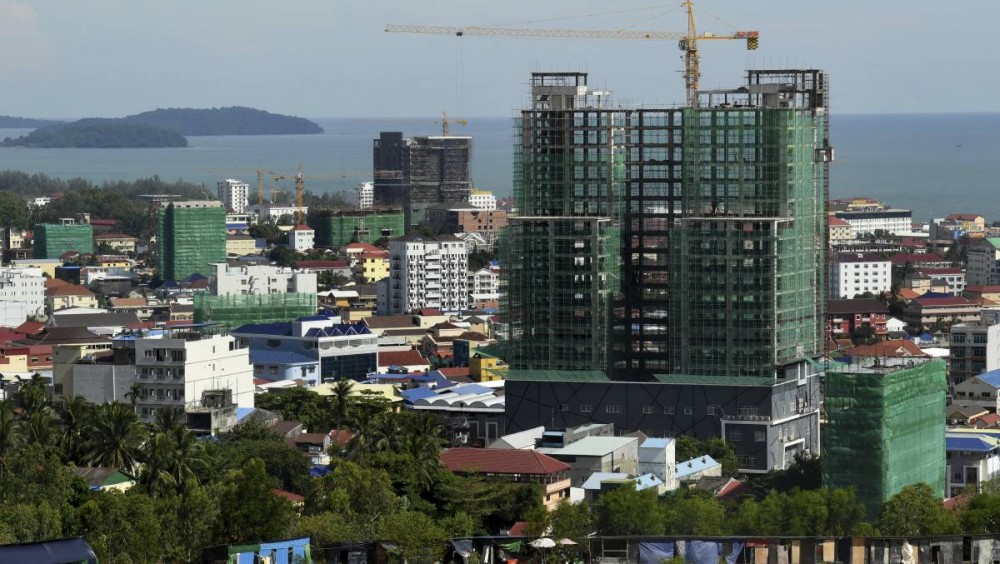
Chinese funds have transformed the Cambodian village of Sihanoukville near the site of the proposed military base. Picture: Kate Geraghty
An intense diplomatic effort is under way to overturn "seriously disturbing" plans for a new Chinese military base after the Australian government concluded that it does not believe public denials of the deal by Beijing and Cambodia.
The secret agreement to station Chinese troops and weapons in the region is a new test for the relationship between Australia and China, after Liberal MP Andrew Hastie stoked fury by likening an inability to contain the emerging superpower to the "catastrophic failure" to stop the rise of Nazi Germany.
The Chinese embassy in Canberra accused the chair of Parliament's powerful intelligence and security committee of a "Cold-War mentality" but Mr Hastie was praised by many Coalition and Labor MPs who believe Australia should take a more aggressive approach to its largest trading partner.
Former foreign minister Julie Bishop agreed Australia must take a long-term view of China but rebuked her former colleague for referencing the Nazis.
"We should be careful in drawing historic parallels, particularly when it refers to one of the darkest chapters in human history," Ms Bishop told The Sydney Morning Herald and The Age.
In an incendiary opinion piece, Mr Hastie warned Australia would face an unprecedented economic and national security test over the next decade as China tightens its grip over the Indo-Pacific.
China strongly denied reports last month of a deal for a 30-year lease over Cambodia's 62-acre Ream Naval Base. The facility would represent Beijing's second overseas military post and offer it extraordinary influence over the heavily disputed South China Sea.
The reports, which Cambodian Prime Minister Hun Sen dubbed "the worst distorted news", prompted Australia to urgently seek more information but officials are deeply unsatisfied with the response and believe the base could go ahead.
Foreign Minister Marise Payne on Thursday noted Cambodia's government had denied the plans.
"Australia and others in the region will monitor developments closely and continue to make enquiries of the government of Cambodia on this issue," she said.
"Australia has a strong interest in regional stability, security and prosperity, and is engaging closely with our partners in support of this goal.
"We would be concerned at the establishment of new military bases that could pose a risk to the sovereignty of countries and undermine the strategic balance in the region."
Senator Payne discussed the Cambodian base with US Secretary of State Mike Pompeo in Sydney on the weekend and agreed to stay in close contact on developments.
One senior national security official said the base plan was "seriously disturbing" and had triggered alarm. The Indonesian government was so concerned by last month's reports that it dispatched an official from Phnom Penh to seek first-hand information.
Australia, the Unites States and a number other countries in the region are quietly working behind-the-scenes to prevent any Chinese military installation on Cambodian territory.
Prime Minister Scott Morrison on Thursday said he was confident Australia's relationship with China could withstand any challenges.
In a notably muted response, Mr Morrison said Mr Hastie was "entirely entitled to provide his perspective.
But a Chinese embassy spokesman suggested the comments could harm "mutual trust" between the two nations.
"We urge certain Australian politicians to take off their 'coloured lens' and view China's development path in an objective and rational way," he said.
Liberal senator James Paterson said senior diplomatic and national security figures were "relieved the political class has finally woken up to this very serious threat".
"Five years ago this would have been a controversial thing to say but not anymore. Andrew's concerns are widely shared."
Labor's foreign affairs spokeswoman Penny Wong condemned the comments and shadow treasurer Jim Chalmers said linking China to Nazi Germany was "extreme, overblown and unwelcome".
But Labor MP Brian Mitchell praised the former SAS captain for a "considered and thoughtful" contribution and others privately supported him.
While not opposing Senator Wong's response, Labor MP Anthony Byrne defended Mr Hastie's right to speak out.
"If anyone has earned the right to articulate his views about threats to Australia's security, that young man has earned his right by his service to our country," said Mr Byrne, the deputy chair of Parliament's intelligence and security committee.
Australian Strategic Policy Institute defence strategy and capability senior analyst Malcolm Davis backed Mr Hastie's assessment.
"At what point do we carry on with these self-denials of what is really happening in the world before we accept reality?" asked Mr Davis.
"There is a risk that if we continue on pretending there's no problem, that we emulate the experience of the mid 1930s. In that period we almost left it too late to respond and we shouldn't be caught short again."
Other government MPs including Tim Wilson and Amanda Stoker also supported their colleague.
"If we are to have a constructive relationship with China in the future than we need to understand their national thinking, goals and psyche and the ways in which they challenge Australian values," Senator Stoker said.
Labor MP Peter Khalil, a former foreign affairs advisor under prime minister Kevin Rudd, suggested Australia should play a bigger role in mediating tension between the US and China.
"Australia no longer suffers the tyranny of distance. In fact, it's the inverse now. We are right in the middle of the centre of what is going to be important for a peaceful and prosperous latter half of the 21st century."
Business Insider:
Reports of a secret base deal are raising fears that Beijing is boxing in the South China Sea
By: Christopher Woody
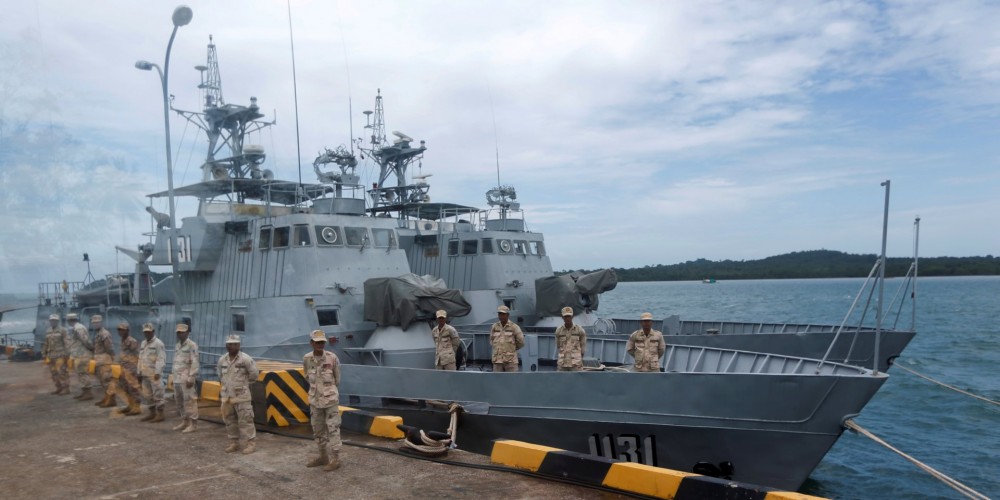
Sailors stand guard at Ream Naval Base in Sihanoukville, Cambodia, July 26, 2019. Reuters
- Reports of a deal between China and Cambodia over a naval base have stoked concerns about Beijing's ambitions in the South China Sea and Indian Ocean.
- China and Cambodia have denied the reports, but the news has the US and other countries reevaluating their relationships in the region.
A report that China cut a deal with Cambodia to use part of a naval base is raising concern that Beijing could extend its reach in the South China Sea and over the Malacca Strait, which connects the Indian and Pacific oceans.
The deal, signed this spring, according to The Wall Street Journal, would give Beijing exclusive rights to a 62-acre section of the 190-acre Ream naval base, near Sihanoukville, Cambodia, and not far from a large airport a Chinese company is building.
US officials who saw an early draft told The Journal that the agreement would permit China to station military personnel, store weapons, and dock warships at the base and to use the facility for 30 years with automatic renewals every 10 years thereafter.
Under the agreement, US officials said, China would build two new piers, one for itself and one for Cambodia, though they said dredging was likely needed for larger Chinese warships to use it.
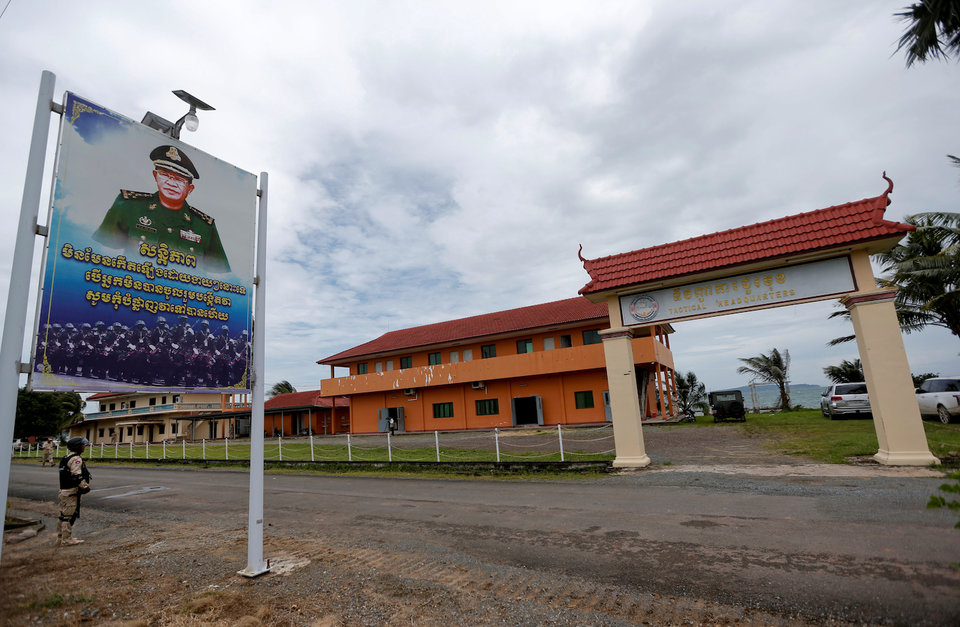
Sailors stand guard at Ream naval base in Sihanoukville, Cambodia, July 26, 2019.REUTERS/Samrang Pring
Chinese and Cambodian officials denied the reports, and Cambodian defense officials took journalists on what was described as a " stage-managed visit" to the base to show there was no Chinese presence, though the areas on display were reportedly limited.
The US and other countries have sounded the alarm about what they see as a growing Chinese presence in the region, pointing to a series of deals along the Pacific and Indian ocean coasts.
While the deals have ostensibly focused on infrastructure and economic activities, observers suspect China has military designs — a concern underscored in Djibouti, where China opened its first overseas base in 2017, though Beijing calls it a "logistics support facility."
"A lot of the strategy we've seen is the Chinese are trying to create a ring from essentially their coastline, the South China Sea, all the way down through the Indian Ocean and down to East Africa," Ben Rhodes, deputy national security adviser during the Obama administration, said on a recent podcast.
"If you look at Cambodia, and then the Chinese are building a big port in southern Myanmar ... then they have a lot of interest in Sri Lanka, [an] island country off the coast of India, then they have this base in Djibouti — it's not hard to see the kind of dotted line that connects a lot of this infrastructure they're building," Rhodes said.
"Some of these are outright military facilities, like in Djibouti," Rhodes added. "Some of these begin as infrastructure projects, ports, that then become used for military purposes."
'Clearly there's something else that's going on'
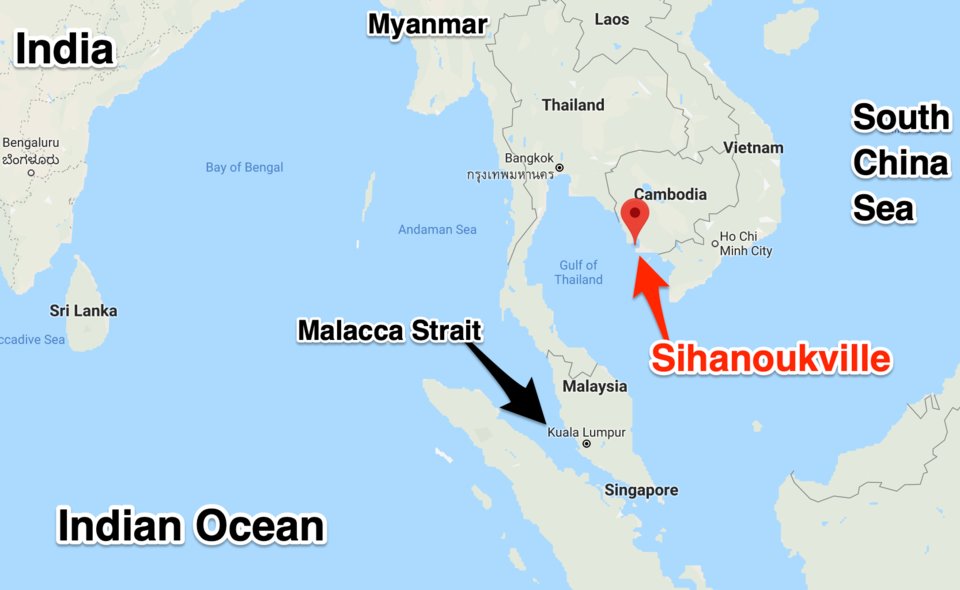
Google Maps
The deal for Ream and Chinese construction of an airport that could handle long-range bombers and military transports at Dara Sakor, an investment zone about 40 miles northwest of the port, has raised concern about Beijing extending the reach of its military.
The company building the airport says it's purely commercial, but it has attracted attention as a potential "dual-use" facility.
"The Chinese have claimed, as they've claimed in other aspects of dual-use facilities, that this is totally economic and is tied to ... Dara Sakor," Prashanth Parameswaran, senior editor at The Diplomat, said of construction around Ream on a recent podcast.
"All the estimates that I've seen are [to] the fact that any kind of economic investment opportunity in this area, when you compare that to what is actually being built, with respect to satellite imagery, it's not enough to support any kind of civilian or economic opportunity in and of itself," Parameswaran said. "So clearly there's something else that's going on."
US officials believe that something could be military in nature.
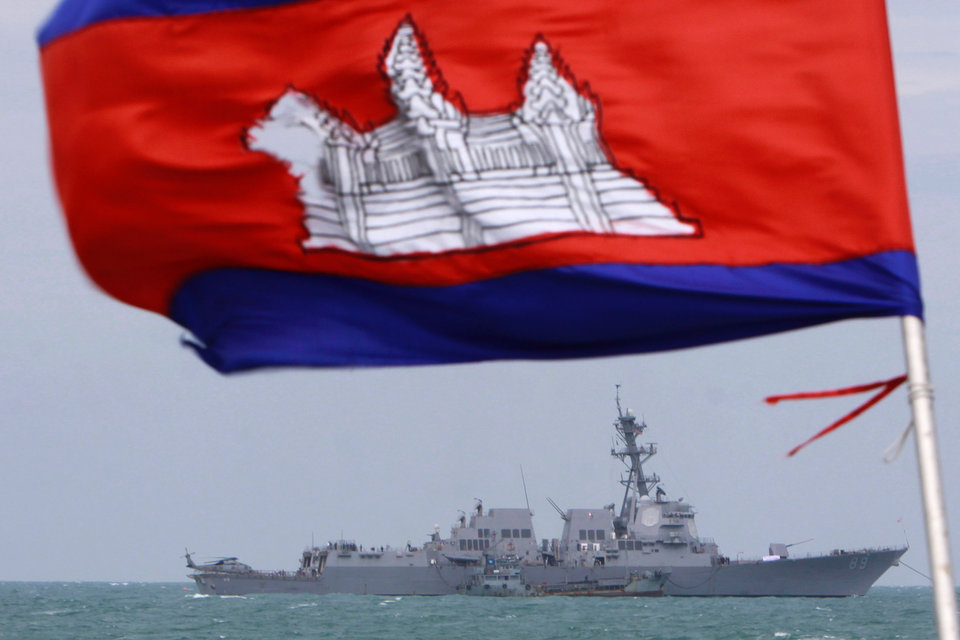
A Cambodian national flag flutters above the USS Mustin at Cambodia's Sihanoukville port, about 137 miles southwest of Phnom Penh, December 3, 2010. AP Photo/Heng Sinith
Coupling a Cambodian outpost with Chinese military facilities on islands in the South China Sea would essentially create "a triangular perimeter boxing in all of mainland Southeast Asia," Charles Edel, former adviser to the US secretary of state, told The Journal.
A US official also told The Journal that a Chinese military presence at either facility would "greatly complicate" the US's ability to come to Taiwan's assistance in a conflict.
Gregory Poling, director of the Asia Maritime Transparency Initiative at the Center for Strategic and International Studies, said a Chinese base in Cambodia was unlikely to resemble Beijing's outposts in the South China Sea, comparing it instead to the Djibouti facility, "which allows a modest Chinese rotational presence."
While details of any deal remain unclear, Poling said in an email, "the base doesn't give China much power-projection capabilities over the South China Sea that it doesn't already have."
"But it could certainly allow Beijing to project power, especially air power, over the Gulf of Thailand, Strait of Malacca, and Andaman Sea in a way it couldn't before," Poling said, adding that projection isn't the same as "control" and that others in area — like the US and India — have their own power-projection capabilities.
US officials are debating whether Cambodia can be convinced to change its mind about the base and reverse what is seen as a shift away from the US and toward Beijing. (A sign something was amiss at Ream, where the US and Cambodia have done military exercises before, came when Phnom Phen suddenly turned down a US offer to repair facilities there.)
'A destabilizing development'
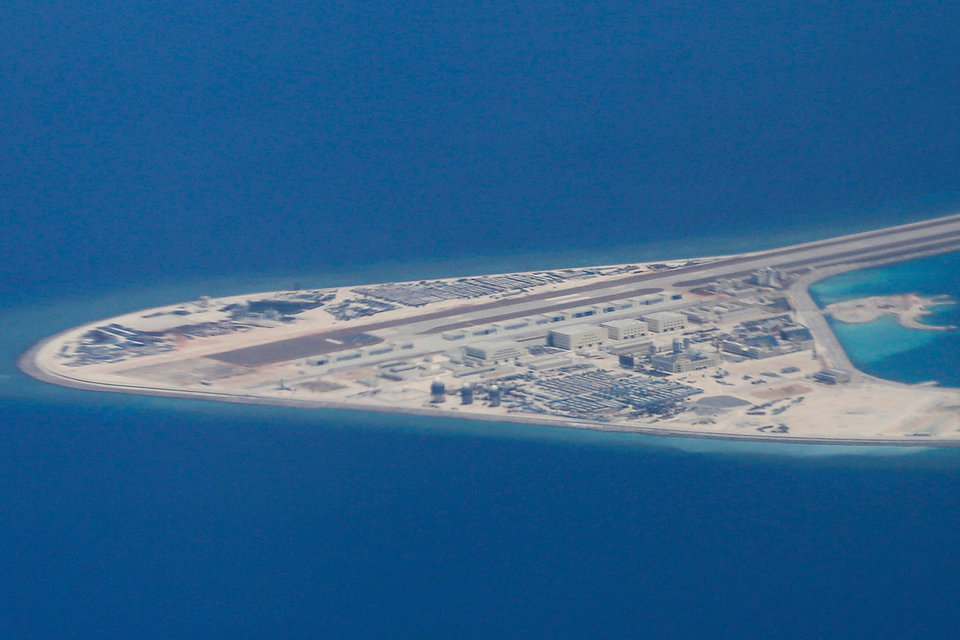
An airstrip and buildings on China's man-made Subi Reef in the Spratly Island chain in the South China Sea, April 21, 2017.Bullit Marquez/AP
News of a potential deal likely has others reevaluating where they stand.
Vietnam and Thailand will be concerned about a growing Chinese military presence in Cambodia, Parameswaran said.
"These are two powers that have wanted significant attention and significant influence in mainland Southeast Asia, so this is something that not only affects the balance of power when you think about the United States and China. It also affects how mainland Southeast Asian countries react with each other, and I think in the last few years the Chinese inroads in Cambodia have also alarmed both Thailand and Vietnam."
Thailand is a treaty ally and now has an elected government that would allow it to pursue closer cooperation with the US, if the Trump administration is open to that, Walter Lohman, director of the Asian Studies Center at the Heritage Foundation, said in an email.
Vietnam's situation is more difficult, given its complicated ties with China. Its government can reach out to Beijing directly but will face internal pressure to do more with the US; it could also appeal to Russia, Lohman said.
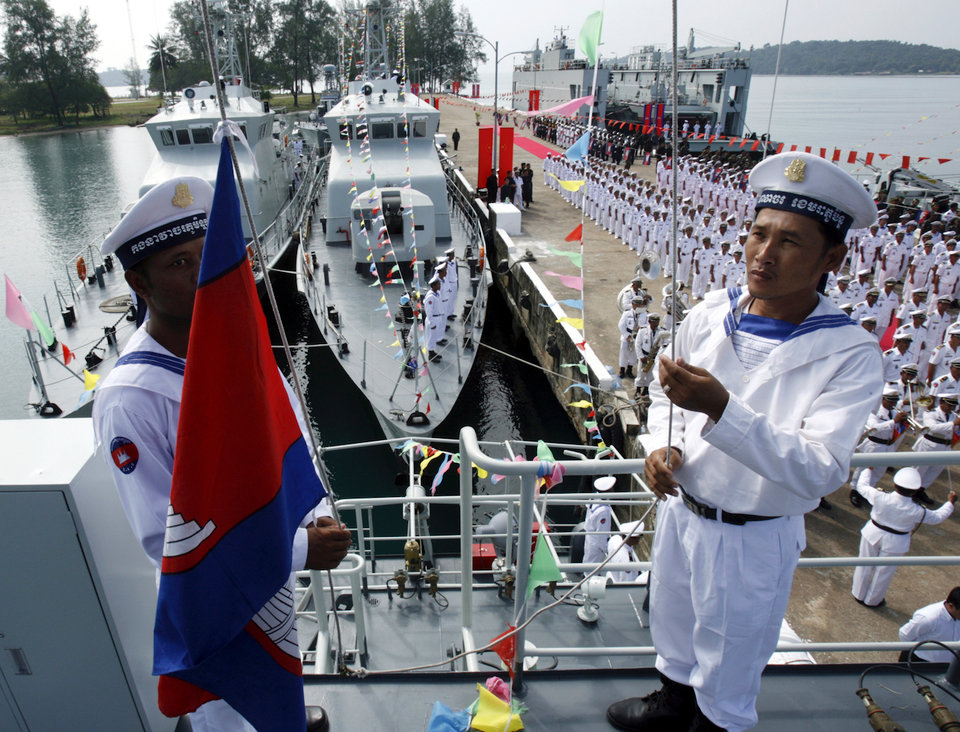
Cambodian sailors raise the Cambodian flag on a Chinese naval patrol boat during a handover ceremony at Ream naval base in Sihanoukville province, southwest of Phnom Penh, November 7, 2007. REUTERS/Chor Sokunthea
While details of any naval base deal remain unclear, "it would be a destabilizing development" and is one that doesn't entirely make sense from China's perspective, Lohman added.
Beijing has built a "significant political-security relationship" with Thailand over the last 30 years, while closer relations with Cambodia have yielded "a lot of diplomatic payout."
China could continue denying reports about a base in Cambodia in order to keep its options open, Lohman said, but a Chinese presence a Ream would likely squander ties Beijing has built in the region.
"Why build a base and complicate the relationship with the Thais when you're already getting so much out of current arrangements?" Lohman said. "If the stories are true, I think the Chinese are overplaying their hand."
 Khmer
Khmer English
 French


