


២១ កញ្ញា ២០២៦ / 21 September 2026
របប ហ៊ុន សែន មិនអាចដោះស្រាយវិបត្តិសេដ្ឋកិច្ចកម្ពុជា ដែលកាន់តែធ្ងន់ធ្ងរឡើង បានទេ
CAMBODIA’S ECONOMIC CRISIS SIGNALS THE END OF A SHORT-SIGHTED GROWTH MODEL
Cambodia’s current economic slowdown is real and is likely to continue at least through 2027. It stems not from a single shock, but from the convergence of several crises: real estate, credit, tourism, relations with Thailand, energy costs, and weakening international confidence.
The IMF estimates that real economic growth, after declining from 6.0% in 2024 to 5.3% in 2025, could fall to around 3% in 2026. The Asian Development Bank is less pessimistic, forecasting 4.1% in 2026 and 4.7% in 2027. The gap between these forecasts illustrates the extent of the uncertainty, but both confirm a marked slowdown. IMF, July 2026, ADB, July 2026.
1. The fading real-estate engine
For years, Cambodia’s growth was largely supported by:
- real-estate investment, particularly from China;
- the construction of housing, hotels, casinos, and commercial buildings;
- rapid growth in bank lending secured by land or property.
This model is now faltering. Many projects have been suspended or remain unsold, land transactions have declined, and quoted prices do not always reflect the prices at which properties could actually be sold.
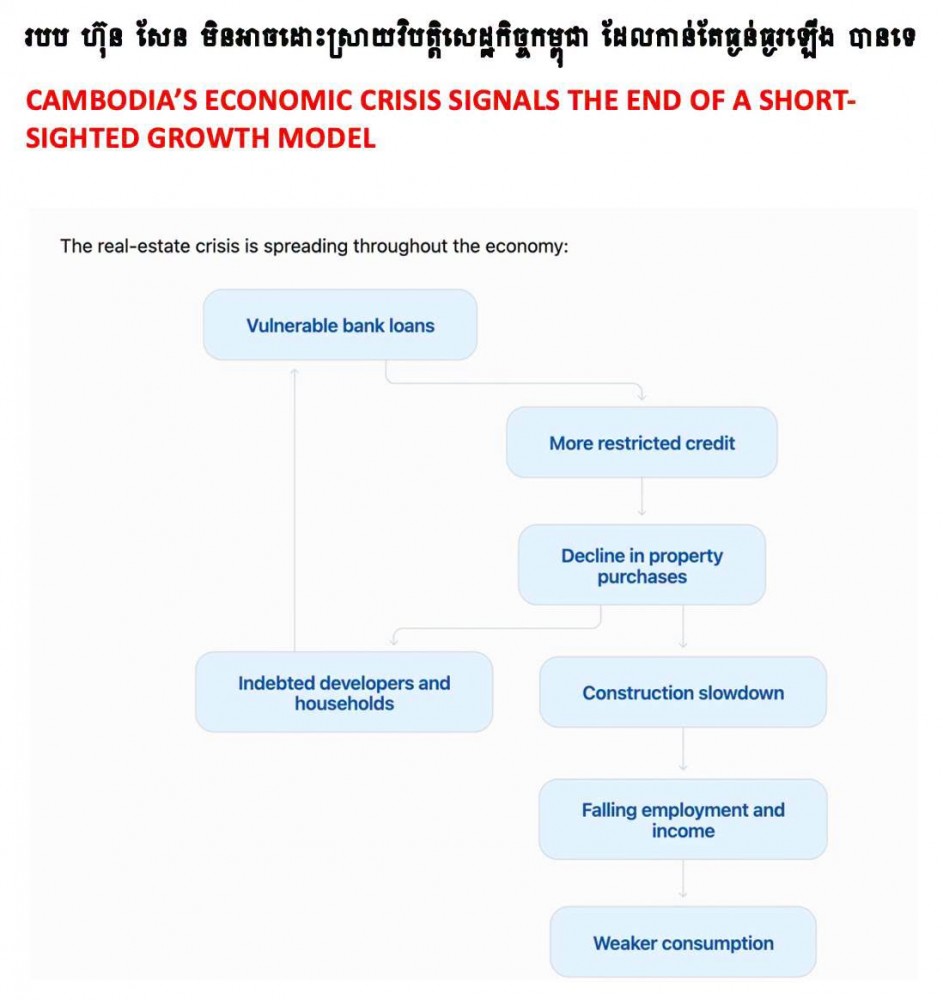
The real-estate crisis is spreading throughout the economy:
The IMF specifically regards real estate and deteriorating bank asset quality as major risks. The problem may be more serious than the officially reported level of non-performing loans suggests, because repayment deferrals and loan restructurings have delayed the recognition of some losses.
2. Insufficient domestic demand
Weakness in real estate and credit is weighing on the incomes of workers, shopkeepers, subcontractors, and property owners. Indebted households are reducing their spending to continue servicing their loans.
This is resulting in depressed domestic demand:
- lower consumption;
- weaker sales for small businesses;
- reduced private investment;
- greater caution among banks;
- pressure on employment and wages.
This is a cumulative mechanism: fear of an economic slowdown encourages households and businesses to postpone spending, which in turn deepens the slowdown.
3. The tourism shock and the Thai border
The prolonged closure or severe disruption of the border with Thailand is affecting:
- tourist arrivals by land;
- casinos, hotels, restaurants, and border businesses;
- transport and informal trade;
- the supply of certain markets;
- Cambodian migrant workers in Thailand and the remittances they send to their families.
The ADB explicitly cites geopolitical shocks and the prolonged closure of the Thai border among the reasons for its downward revision.
Beyond the border dispute, Cambodia’s tourism industry faces intense regional competition. Thailand, Vietnam, and Malaysia offer more diversified tourism products, better connectivity, and often better value for money.
4. Declining remittances from migrant workers
The return of some Cambodian workers previously employed in Thailand is producing a double shock:
- they lose all or part of their income;
- their families in Cambodia no longer receive the same level of remittances.
The IMF reports that declining remittances contributed to the deterioration of the current account in 2025. At the same time, Cambodia’s labour market must absorb those returning home while construction and domestic demand are already weak.
5. Highly concentrated and vulnerable exports
Exports remain an important source of support, but they are concentrated in a limited number of sectors:
- garments, footwear, and travel goods;
- bicycles and certain manufactured products;
- agriculture and agro-industry;
- a few emerging electronics activities.
This concentration exposes Cambodia to slowing demand in the US and European markets, changes in tariffs, and competition from countries such as Vietnam, Bangladesh, and Indonesia.
The model based on low-cost labour is also reaching its limits: wages and logistics costs are rising without equivalent gains in productivity, skills, or domestic value added.
6. Higher energy costs and inflation
Cambodia imports much of its fuel and many production inputs. Rising energy prices therefore affect:
- transport;
- electricity and production;
- food prices;
- business costs;
- household purchasing power.
The IMF forecasts average inflation of approximately 5.6% in 2026, compared with 2.5% in 2025; the ADB forecasts 4.5%. Cambodia therefore faces a form of inflationary slowdown: weaker growth combined with higher prices.
This situation is particularly painful for low-income households because their earnings are increasing only slowly, while food, transport, and energy account for a large share of their budgets.
7. Dependence on China
China remains an essential source of investment, tourists, and financing. However, China’s property crisis, greater investor caution, and reduced capital outflows are weakening the momentum from which Cambodia previously benefited.
The problem is not merely the quantitative decline in Chinese capital. Some previous investments were heavily concentrated in real estate, casinos, and projects with limited integration into the wider economy. They generated economic activity, but not necessarily a diversified and sustainable industrial base.
8. Scam centres and reputational damage
The IMF explicitly mentions the reputational damage associated with scam activities. This can affect:
- tourism;
- the confidence of legitimate investors;
- relations with international banks;
- the cost of financial-compliance controls;
- the country’s overall image.
This is therefore no longer merely a criminal or diplomatic problem. It has become a genuine macroeconomic and financial risk. A damaged reputation discourages productive investment precisely when Cambodia needs to replace speculative capital with higher-quality industrial investment.
9. Institutional weaknesses limiting economic transformation
The current difficulties reveal deeper weaknesses:
- legal uncertainty and uneven enforcement of rules;
- corruption and close ties between political, banking, and real-estate interests;
- insufficient statistical transparency;
- inadequate professional and technical skills;
- relatively high electricity and logistics costs;
- limited production diversification;
- a narrow tax system dependent on a limited number of taxpayers.
These factors prevent the transition from growth based on land, credit, and low-cost labour to growth based on productivity, technology, and the rule of law.
Outlook for 2026–2027
The most likely scenario is not necessarily a recession in the strict sense, but growth that is far too weak to:
- absorb new entrants into the labour market;
- provide jobs for workers returning from Thailand;
- reduce poverty significantly;
- resolve real-estate and banking difficulties;
- quickly restore the growth rates of 6–7% previously recorded.
Conclusion
The current slowdown primarily reflects a crisis in Cambodia’s growth model. The country had relied on four engines—real estate, credit, Chinese capital, and low-wage industries—which are all losing momentum simultaneously.
External tensions are accelerating this process, but they are not its sole cause. Without cleaning up bank balance sheets, resolving real-estate problems transparently, strengthening the rule of law, credibly combating criminal networks, diversifying industry, and investing in skills, any recovery in 2027 is likely to remain weak and fragile.
In other words, Cambodia is not merely experiencing a cyclical slowdown: it is reaching the end of a growth model that must be fundamentally renewed.
Sam Rainsy
 Khmer
 English
 French


